There’s a scene in “Saving Private Ryan” that absolutely wrecks me every time I watch the film, which up to this point is quite a few times. (I’ve lost count.) It’s the scene where Mrs. Ryan, the mother of four sons who are all serving in combat roles in the U.S. military, is in her kitchen washing dishes when she sees an Army car making its way up the dusty driveway to her farmhouse in rural Iowa. When she sees the large white star on the side of the olive drab vehicle she instantly stiffens, her mouth frozen in a rictus. Walking robotically to the door, we see her open the screen door as the Army vehicle pulls up and an officer steps out, followed by a priest. Watching from behind, we see her collapse on the porch as the occupants of the car rush to comfort her. Three of her four sons, we are about to learn, were dead, having fallen in theaters of war in Europe and the Far East.
There are few scenes in the world of movies that more effectively communicate the horrors of war—not the fear of the battle itself, but the dread of parents who wait constantly at home, hoping always that their children will return unscathed but then confronted with the awful reality that that was never going to happen.
The Steven Spielberg film, revolving round an attempt to save a young paratrooper from being killed following the deaths in battle of his three brothers, is loosely based on a real event in WWII. The Niland brothers were four young men who all served in combat roles in that conflict. In June of 1944 two of the brothers were killed in action and a third was missing, believed dead. (It emerged later that he had in fact been captured by the Japanese and survived.) Nevertheless, believing three of the four brothers to be dead, the authorities pulled the last brother, Fritz Niland, from combat in Normandy and shipped him back home. More broadly, the military in World War II tried to make sure that brothers were kept separated from each other, primarily to reduce the possibility of having an entire generation of one family wiped out at the same time. When that policy was not enforced, inevitably there were tragedies, such as the deaths of the five Sullivan brothers of Waterloo, Iowa who were all serving on a US Navy cruiser sunk by a Japanese submarine in 1942. None of the brothers survived the sinking.
All deaths in war are tragic, but when those deaths are concentrated within a family unit, the tragedy is that much more awful. Something similar holds for small towns or neighborhoods that suffer disproportionately high casualty rates in time of war.
Which brings me to Bedford, Virginia. Sitting in sight of the Blue Ridge Mountains to the north, this is a pleasant though unremarkable place in most respects, except when it comes to World War II and specifically the Normandy landings of June 6, 1944. On that day, D-Day, 37 of Bedford’s sons were in Company A, 116th Infantry Regiment, 29th Division as part of the first wave of the huge Allied force storming Omaha Beach. By day’s end, 20 of those 37 were dead. Over the course of the 12-week Normandy campaign another three would die. Against the backdrop of the Second World War’s horrific toll 23 deaths might not sound that much, but in the context of Bedford, a town of only 3200 at the time, it was shattering. It gave this small Piedmont community the somber distinction of suffering the country’s highest per-capita loss that day.
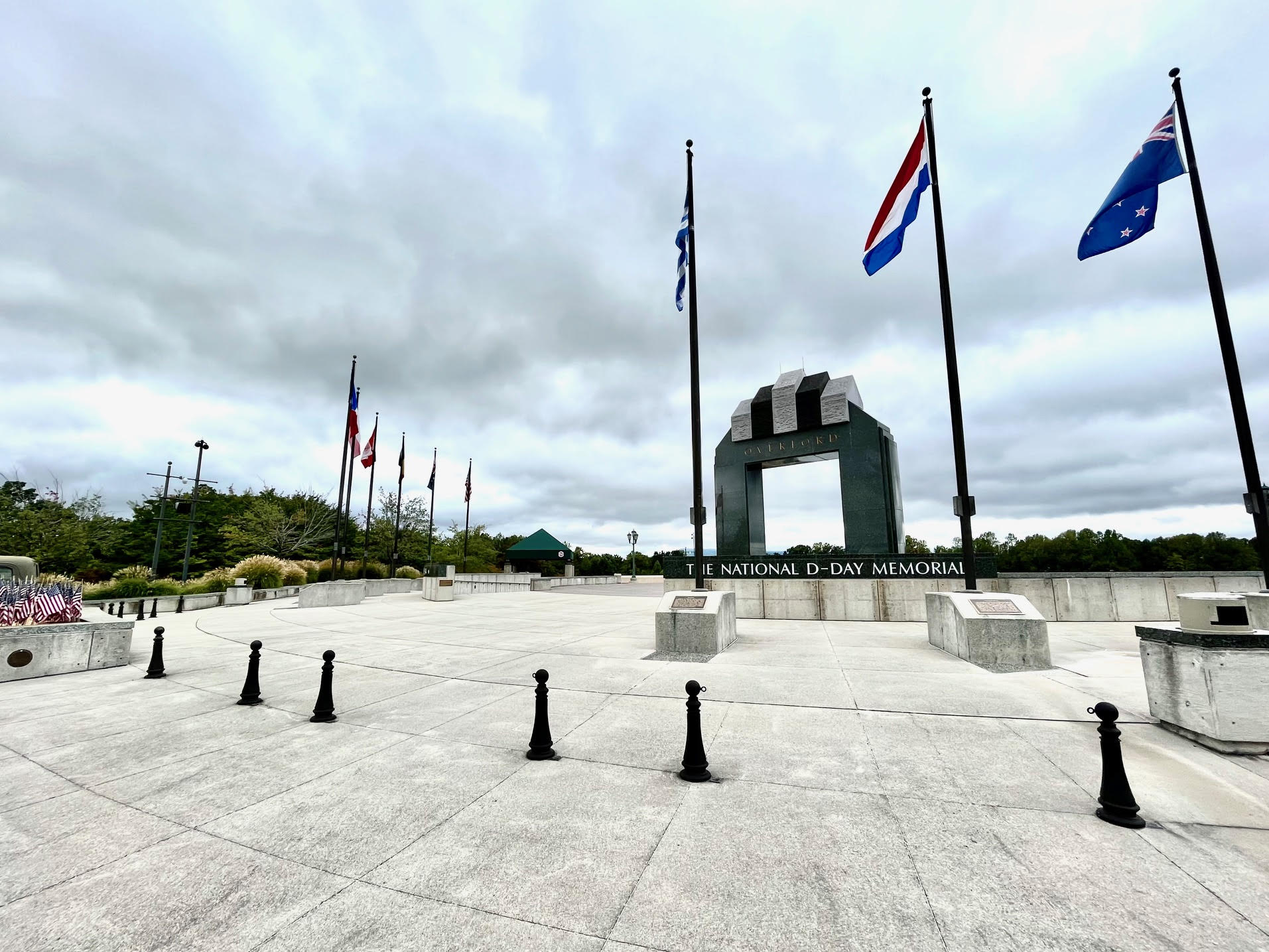
The deaths of those young men was a key reason why the country’s National D-Day Memorial was sited there in 2001. Even so, the memorial might have never come to pass but for the efforts of a Normandy veteran, Bob Slaughter, who led efforts in the late 1990s to create a permanent memorial site in the United States. Those efforts paid off in 2001, when the D-Day Memorial was dedicated by President George W. Bush.
(Photo credit: Estes Plaza and Overlord Arch, National D-Day Memorial, by Dougie Bicket)


Pingback: What do we mean by public culture? | Dougie Does Monuments·