When the Lincoln Memorial in Washington, DC was dedicated in 1922, the man doing the dedicating was a president who is half-forgotten to history, and when he is remembered it’s usually for bad things, like his death in office and the multiple scandals that later emerged to tarnish his reputation. That man was Warren G. Harding.
It’s illuminating to consider Harding, the 29th president, alongside Lincoln, the 16th holder of that office. If you look at historians’ rankings of presidents—something that seems to be a popular parlor game among that group of professionals—Lincoln invariably comes in the top 3. Poor old Harding, though, is usually rated near the bottom, right down there with such ne’er-do-well chief executives as Franklin Peirce and James Buchanan.
I was thinking about this contrast the day I visited the Warren G. Harding Presidential Home and Library.
You can’t say “President Harding” without saying “Teapot Dome.” This is one of those scandals in U.S. history that for the longest time threw me for a loop. I came across the term a few times in books and magazine articles over the years, but it always seemed to be mentioned in passing, and no-one ever seemed to bother explaining what it was all about. Instead, in my memory, one author after another would just breezily say that such-and-such an affair was “the worst scandal in American politics since Teapot Dome” and was just assume the reader would instantly get it and be suitably appalled.
The thing is, I didn’t get it. I mean, I understood that Teapot Dome was a Bad Thing, but that was about it.
You’d think that at some point I’d get around to doing some research on the term. But for the longest time I didn’t. While the scandal caught my attention—enough that I always remembered it from previous occasions it had cropped up—I never actually bothered to look it up. (And to be fair to myself, when I first heard the term it was long before Wikipedia was a thing, and there was never a set of Encyclopedia Britannicas kicking around when I needed them.)
Anyway, instead of actually researching Teapot Dome, I’d lazily conjure up images in my head about just what had made that particular scandal so godawfully bad. These images were ill-formed at best, but typically revolved around some sort of Alice-in-Wonderland teapot or teapots residing in a wonderfully ornate, Victorian dome or structure that was somehow steeped in scandal. How exactly the federal government came to be interacting with the characters from this Lewis Carroll world was never completely clear to me, but I guessed it probably involved some evil Boss Tweed-like character doing unspeakable things to ordinary citizens just trying to get on with their lives. And surely President Whatshisname was in it up to his ears, the scoundrel.
Sometimes, I assume, all those references to Teapot Dome in my ignorant past included the name Warren G. Harding. Harding served as president from 1921 to 1923, right after Woodrow Wilson. But his name that didn’t stick with me nearly as much as, you know, Teapot Dome.
Anyway, after something like 15 years and god-knows-how-many exposures to the term, I finally made a concerted effort to get to the bottom of what this Teapot Dome thing was all about. (Also, not coincidentally, Wikipedia had helpfully appeared on the scene by this point).
Just in case you don’t have Wikipedia handy, “Teapot Dome” was a bribery scandal involving Harding’s Secretary of the Interior, Albert Bacon Fall, who leased federal petroleum reserves to oil companies at cut-price rates without competitive bidding. One of those reserves was in Teapot Dome, which is actually a location in Wyoming. Inevitably, a Senate investigation uncovered the tawdry deal and Secretary Fall was convicted of accepting bribes from the oil companies and went to jail. Even though Harding himself was not directly implicated in the deal, Teapot Dome was just one of a number of scandals that came to haunt his administration.
So when I visited the Warren G. Harding Presidential Home and Library, the first thing I searched for was their take on the Teapot Dome scandal. Sadly, I have to say, there wasn’t much. There were exhibits about his time as a newspaper publisher and his grand tour to the West Coast and Alaska. But very little about the scandal that, at least in the history books, defined his presidency.
The Warren G. Harding home, in Marion, OH, is now managed by the Ohio Historical Society on behalf of the state. Harding built this home in 1890 and resided there for 30 years, right up till his presidency. After his death in 1923, Harding’s widow willed the house and all the furnishings to the Harding Memorial Association, which in 1978 donated the site to the State of Ohio. This house is listed on the National Register of Historic Places but is not designated as a National Historic Landmark.
As noted above, Harding’s other claim to fame (apart from Teapot Dome) was that of being one of those presidents who died in office. Less well known is that he was also, prior to entering politics, a newspaper publisher.
When Harding ran, it was because he was kind of pushed into it by the Republican Party. He was quite happy serving as one of Ohio’s two senators and didn’t need the hassle of running for the top job. However, when Teddy Roosevelt died in January 1919, it threw the Republican side of the race wide open at a time when the country was clearly ready for a break from Democratic presidents and Wilsonian adventures in wartime Europe. Harding’s campaign slogan—which turned out to be hugely popular in 1920—was a call for a “return to normalcy.”
It’s probably worth mentioning that Ohio has a thing for crafting U.S. presidents. No fewer than eight chief executives can claim deep roots in the Buckeye State, All, apart from Harrison, were Republican. Unfortunately, Ohio presidents have a bad track record when it comes to making it to the end of their elected terms. William Henry Harrison (not born in Ohio but moved there to represent the state in the House of Representatives and the Senate) is famous for having served the shortest term in U.S. presidential history: 32 days, during which time he caught a cold that developed into fatal pneumonia. James A. Garfield got shot in 1881, as did William McKinley 20 years later.
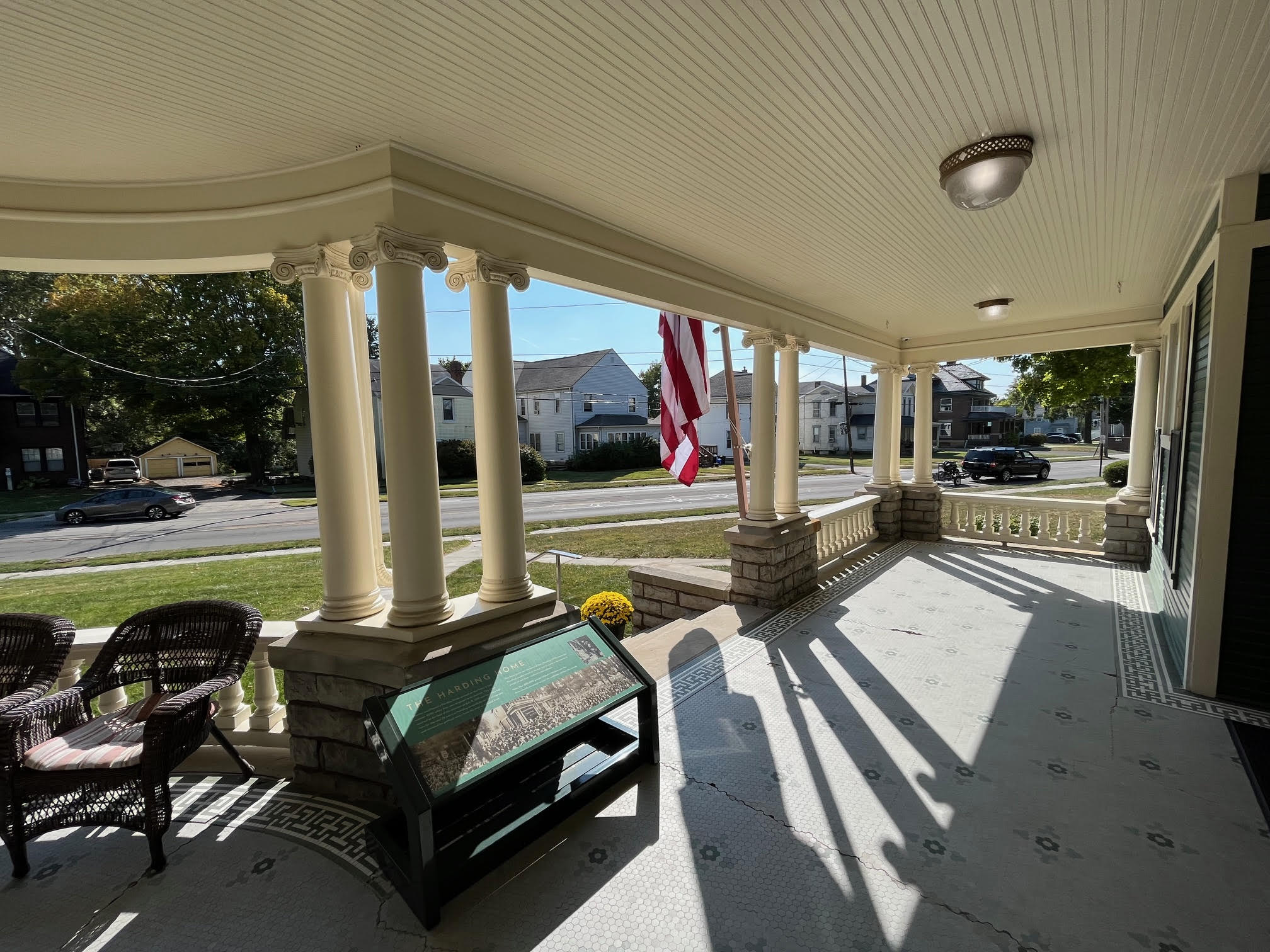
One more thing Harding’s sometimes remembered for is bringing back the “front porch” style of campaigning, which had been associated with earlier Ohio-based presidents such as Garfield and McKinley. That means he actually used his front porch as a regular campaign stop, speaking to repeat crowds of hundreds of people who had travelled from all over Ohio and beyond to hear him speak.
It’s kind of a shame we don’t remember more about Harding. When he won in November 1920, it was with one of the biggest majorities in U.S. presidential history. And he remained popular throughout his presidency. The political scandals—and the extramarital affairs, of which there were many—were, for the most part, only revealed after his death, and they’ve succeeded in clouding history’s judgment of the man.
I wonder what Harding was thinking that day, as he dedicated Lincoln’s Memorial on behalf of the grateful nation he represented. Did he fantasize about being given the chance to become as great a president as his illustrious predecessor? Who knows, but as far as the historians of the world are concerned—and just about everyone else—that was never going to happen. Harding did have one other important thing in common with Lincoln, though: He died in office, though from apparent heart failure rather than assassination. Still, I don’t think we’ll be seeing a monument to Warren G. Harding on the National Mall anytime soon.
(Photo credit: Front porch, Warren G. Harding Presidential Home and Library, Marion, OH, by Dougie Bicket)
 Dougie Does Monuments
Pingback: Lyndon Baines Johnson Presidential Library | Dougie Does Monuments·