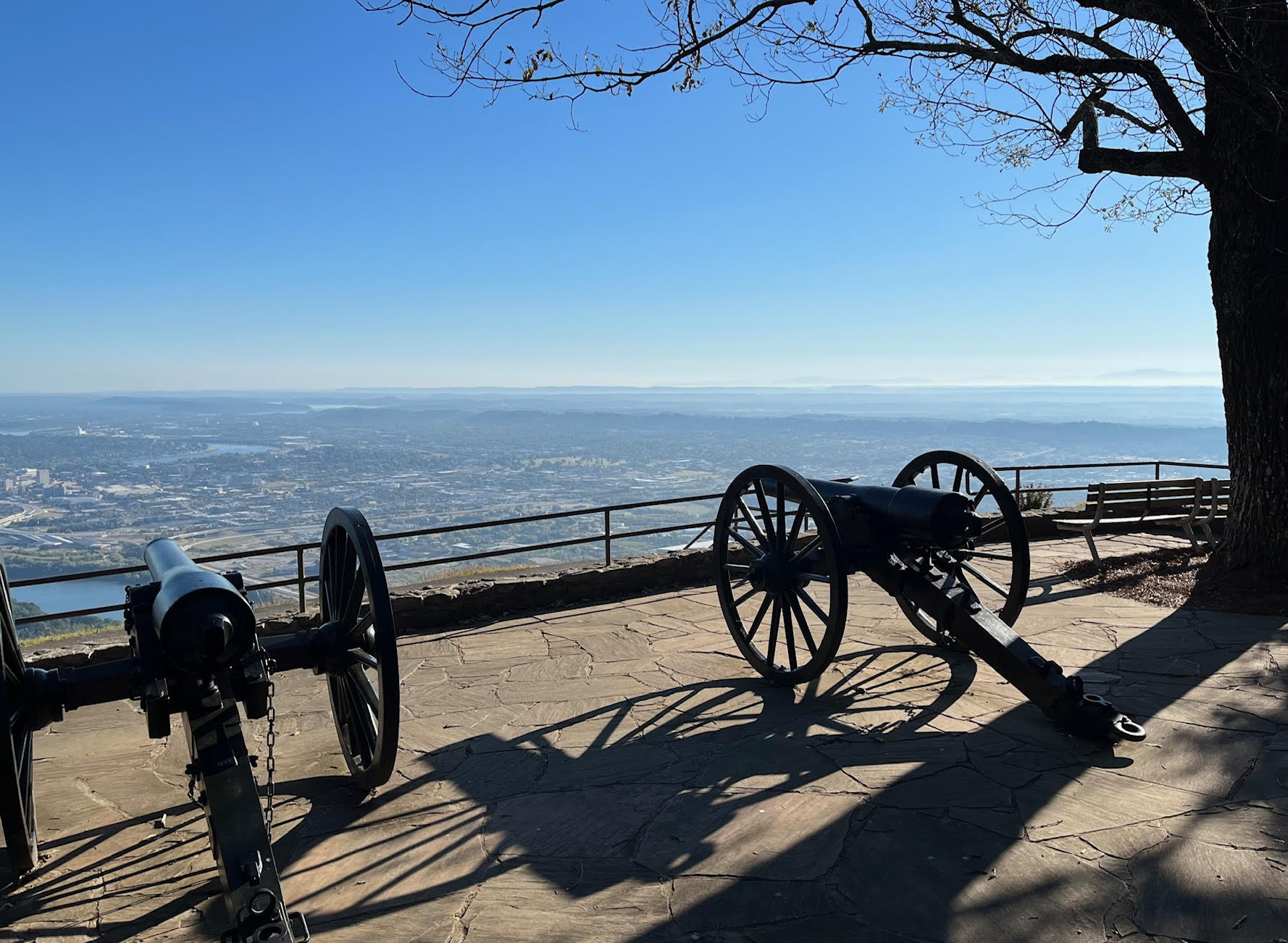
Point Park, on Lookout Mountain, Tennessee is known for its stunning views of Chattanooga and the Tennessee River, almost 2,000 feet below. It also has an amazing entrance, entirely built of stone, which includes a barbican topped by a crenelated battlement and enclosed with two very castle-like towers. When I got there the entrance looked weirdly familiar. I later figured out why while reading the brochure for Chickamauga and Chattanooga National Military Park, which includes Point Park. It informed me the entrance was built by the Army Corps of Engineers in 1904, and it was intended to look exactly like the Corps’ “castle” logo, which is still in use today.
Getting to Park Point was fun, as it involved some rather exciting motoring up steep roads and switchbacks.Fortunately, the day I visited the site the weather was clear and sunny, so I got some magnificent vistas.
At the top there’s an even more spectacular view of Chattanooga to enjoy. But before taking that in I was compelled to first head over to the park’s centerpiece: the New York Peace Monument, a 95-foot column topped by a Confederate and Union soldier shaking hands. Completed in 1907, it was intended to showcase reconciliation between North and South, so the four bronze plaques placed around the base of the monument contain names and unit designations from both sides. But there was one name in particular I wanted to find. It didn’t take long to track it down, as it was quite prominently displayed on the monument’s east-facing plaque: Edmund Pettus.
Many people will be at least vaguely familiar with that name because it also appears in large black letters on a rather famous bridge in Selma, Alabama. The Edmund Pettus Bridge was the scene of a 1965 confrontation between police and civil rights protesters. When I say “confrontation,” I actually mean “police riot.” This was during the first Selma to Montgomery march, on March 7 that year, when around 600 peaceful civil rights marchers, including John Lewis and Hosea Williams, were marching across the span to the south bank of the Alabama River. They were confronted by a wall of state troopers backed up by a posse of white men hurriedly deputized by the city’s sheriff. The cops charged into the marchers, firing tear gas and swinging bullwhips and batons. Seventeen marchers were hospitalized and dozens more were injured. You’ve probably seen photographs or TV images of this encounter, which has become known to history as “Bloody Sunday.” In many of those images, where marchers are being brutalized, you can clearly see the “Edmund Pettus Bridge” name in the background, on a bracing beam connecting the bridge’s arches. The event became a key moment in the Civil Rights struggle of the ’60s and has been memorialized in media productions as varied as the PBS documentary series Eyes on the Prize and the 2014 movie Selma.
(Photo credit: Lookout Mountain, Chickamauga and Chattanooga NMP, by Dougie Bicket)
 Dougie Does Monuments