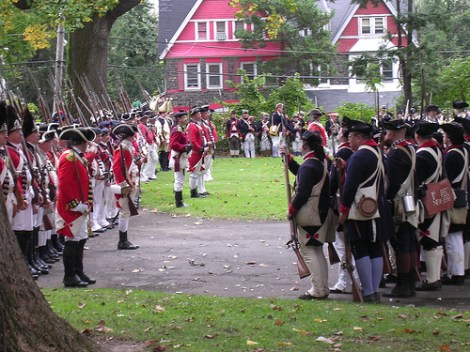
(Photo credit: Reenactors at the Battle of Germantown, post-game handshake, courtesy Michael Feagans, Flickr Creative Commons)
October 4, 1777 saw the Battle of Germantown, where an attempt by Gen. George Washington to attack and defeat the British army invading Philadelphia was defeated and repulsed.
It’s a bit difficult memorializing this particular battle. In 1777 Germantown was just a hamlet, but the site today is a very built-up (and somewhat run-down) city neighborhood northwest of downtown Philadelphia. So there is no big sign announcing you are entering an historic battlefield. There is no driving tour of the British and Continental positions, as there would be at a rural battlefield site such as Saratoga or Yorktown. Instead, most of the 1777 positions and marching routes are, not surprisingly, under concrete and asphalt. Another reason the battle is not particularly well memorialized is because Germantown was a defeat for the Continentals. George Washington had attacked the large British force camped here in the hope that he could defeat it and dislodge the British from Philadelphia (occupied on September 26 after the American defeat at Brandywine). It was a close-run thing, but ultimately he failed to do that.
Given the urban landcape, it’s usually pretty hard for today’s visitor to Germantown to get a clear sense of how the whole engagement played out—with one annual exception. On or near the anniversary of the battle, there is a reenactment that tries to hold as closely as possible to the original positions of the Continental, British, and Hessian forces. Up to 300 re-enactors have taken part in recent years, and they actually march up and down modern streets, on modern asphalt, as they take up positions. Naturally the streets are closed for the event.
The one part of the 1777 battlefield that hasn’t changed much is the historic Chew House, also known as Cliveden. This house and its grounds also form the core of the reenactment. Built in the 1760s by Benjamin Chew, Cliveden played a key role in the events of Oct. 4, 1777. It was the site of a successful British defense against a Continental Army siege. On the day of battle, Continental forces under Anthony Wayne and John Sullivan pushed back the main British line but bypassed the house of Benjamin Chew. About 100 British soldiers barricaded themselves in the house and withstood repeated attempts by the Continentals to dislodge them. Eventually British reinforcements marching up from Philadelphia pushed back the attacking Americans. That pretty much marked the end of Washington’s 1777 campaign to tackle the British. He eventually set up camp in Valley Forge for the winter of 1777-78 while the British army sat tight in Philadelphia.
At least for one weekend of the year, Germantown’s history comes to life and people get a chance to learn—in a fun way—about an important event in America’s revolutionary history. And for the rest of the year there’s always the Chew House, open to the public. Now the most important historic structure in Colonial Germantown Historic District, Cliveden is a U.S. National Historic Landmark, operated by the National Trust for Historic Preservation.
 Dougie Does Monuments
Warfare is a fascinating subject. Despite the dubious morality of using violence to achieve personal or political aims. It remains that conflict has been used to do just that throughout recorded history.
Your article is very well done, a good read.